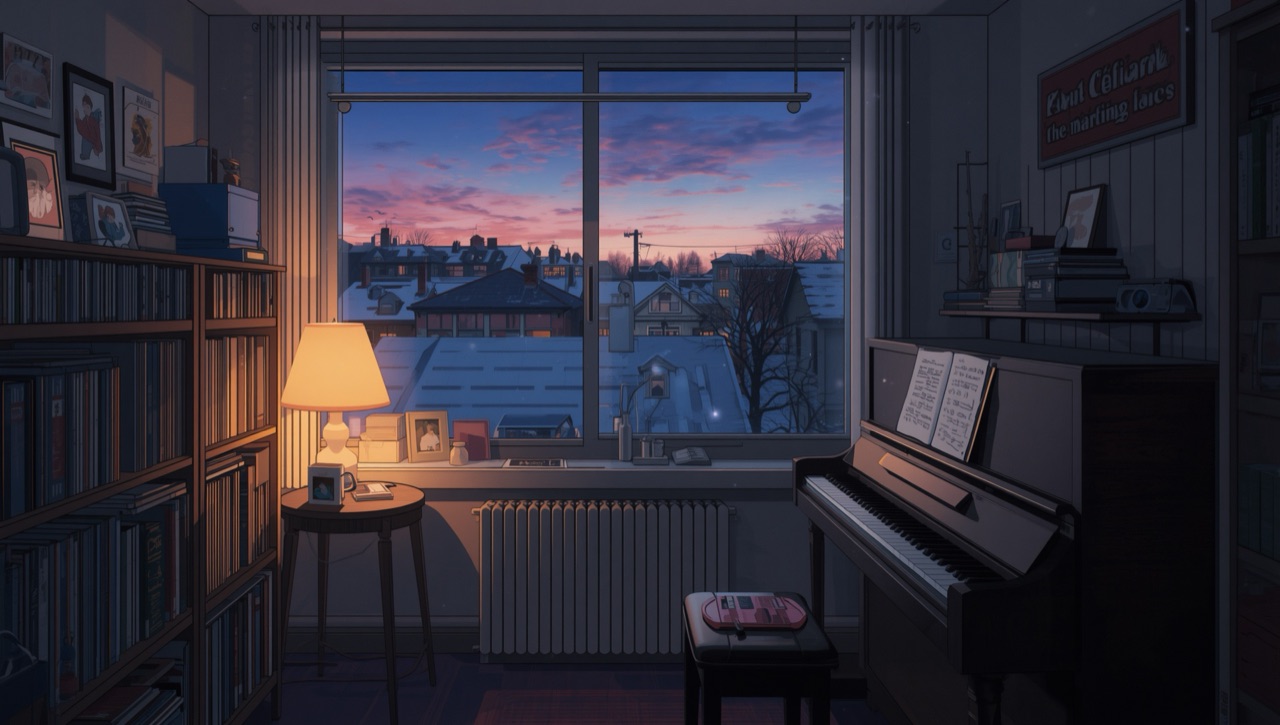
Most lofi uses a few chord progressions built from "extended" chords: major sevenths, minor sevenths and ninths, which sound warmer and more open than plain triads. The eight below are written in C major (or A minor) so you can play them on the white keys and a few black ones. Each comes with the mood it gives and a tip for using it.
A quick key to the names: maj7 adds the note just below the octave to a major chord (warm, dreamy); m7 does the same for a minor chord (soft); 9 adds the note above the octave (open, floaty); a plain 7 on a major chord (like G7) is the "leaning" dominant chord that wants to resolve.
1. The two-chord drift: Cmaj7 → Am7
Two chords, back and forth, forever. This is the most "lofi" progression there is: nothing resolves, nothing surprises. Perfect for study tracks.
Tip: keep your hand in one place and move as few fingers as possible between the chords. The smaller the movement, the smoother it sounds.
2. The jazz cadence: Dm7 → G7 → Cmaj7
The ii–V–I, the backbone of jazz. It sounds like arriving home. Slowed to lofi tempo, it feels like a sigh.
3. The sentimental walk down: Fmaj7 → Em7 → Am7
Each chord steps down. It sounds nostalgic, a little sad, like looking out of a window. Loop it with a slow kick and a vinyl crackle and you have a rainy-day track.
4. The extended cadence: Dm9 → G13 → Cmaj9
The same ii–V–I as number 2, but every chord gets an extra colour note. This is the sound of polished jazz-hop: lusher, more expensive, more "Sunday apartment".
5. The float: Cmaj7 → Fmaj7
Two major sevenths a fourth apart. Bright, peaceful, unhurried. A good morning or coffee progression.
6. The turnaround: Am9 → Dm9 → G7 → Cmaj7
Four chords that cycle back to the start neatly, so the loop always feels like it's going somewhere. Use it when a two-chord loop feels too static.
7. Minor and rainy: Am9 → Dm9
A minor version of the two-chord drift. The ninths stop it from sounding gloomy; it's wistful instead. Most "rainy lofi" lives here.
8. The famous one: Fmaj7 → E7 → Am7 → Gm7 → C7
Often called the "Just the Two of Us" progression, after the 1980 song that made it famous. It's everywhere in lofi, city pop and neo-soul, because the E7 in the middle gives a bittersweet twist before landing on Am7.
How to make any of them sound like lofi
- Play them on an electric piano sound, a Rhodes if you have one.
- Hold the bass to one note per chord, low and soft.
- Put the chord slightly late, behind the drum beat, instead of exactly on it.
- Add texture: vinyl crackle, tape saturation, a little pitch wobble.
- Keep the tempo slow, around 70 to 85 BPM.
Using them with AI tools
AI music tools like Suno don't reliably follow chord names typed into a prompt, so describe the result instead: "jazzy major seventh chords on a warm electric piano", "wistful minor ninth chords", "a slow jazz ii-V-I feel". Our own style prompts, with what they produced, are in Suno lofi prompts: the real ones behind our albums.
Hear the sound
If you want to hear what these chords sound like in finished tracks, lofi jazz explained walks through the style, and our lofi jazz room is full of maj7 and m9 warmth.
And if you're new to all of this, what is lofi music covers the other ingredients: the drums, the texture and the tempo.
Written by Suman Kumar with AI help and checked before publishing. Numbers about our own music come from our Spotify for Artists and DistroKid exports; other sources are linked in the post.