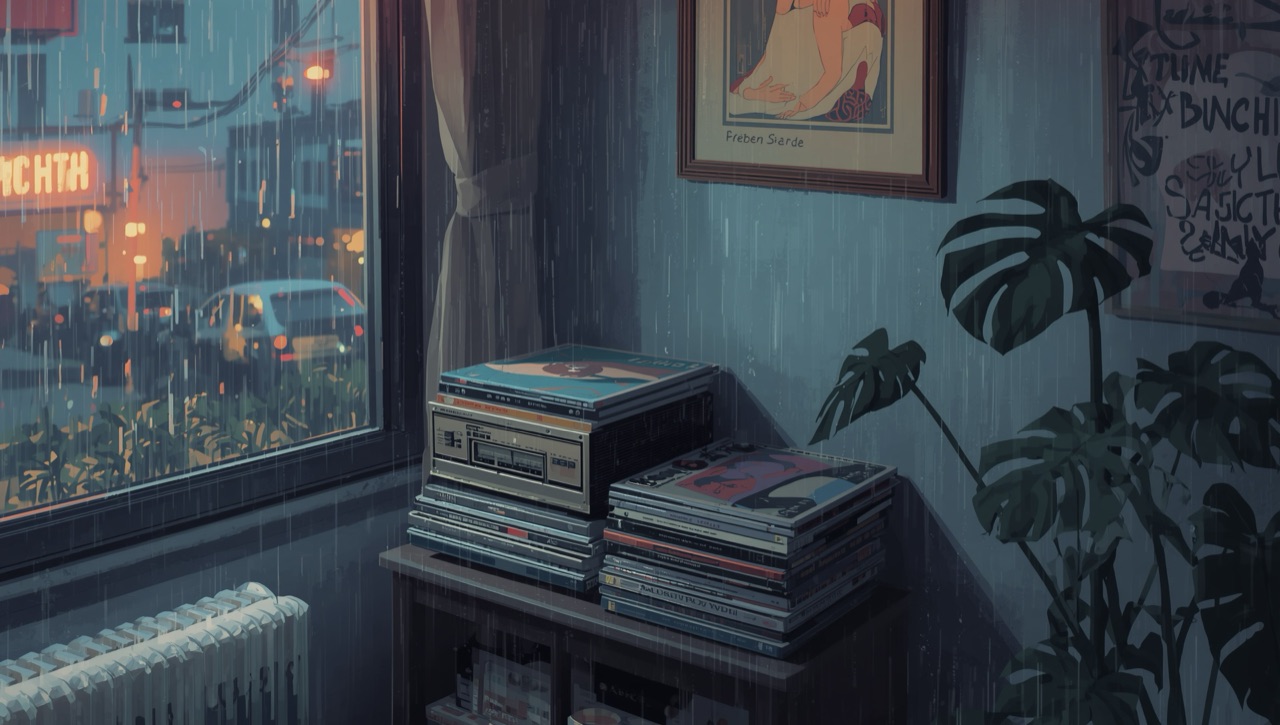
Lofi means low fidelity: sound that isn't faithful to the original, with hiss, crackle, wobble and a narrow, muffled tone. It's the opposite of hi-fi, the "high fidelity" that record players and stereos were sold on from the 1950s. What started as a description of cheap recordings became a style people chose on purpose, and lofi hip-hop took the name for its dusty, sampled sound.
Hi-fi came first
"High fidelity" was a selling point in the 1950s: records and players that reproduced sound so faithfully it was like being in the room. Once hi-fi was the goal, anything that fell short, like a home tape recording, a worn record or a cheap microphone, was "low fidelity". The early Oxford English Dictionary definition of lo-fi was simply sound production "less good in quality than hi-fi".
A radio show turned it into a style
The word got a second life in the 1980s. From 1986 to 1987, the independent New Jersey station WFMU ran a weekly show called Low-Fi, hosted by William Berger, playing home recordings made on cheap equipment. The station's magazine described them as "technical primitivism coupled with brilliance", which is still a good description of the appeal.
From there, "lo-fi" came to mean music that's rough on purpose: indie bands recording on four-track cassette machines, bedroom producers, anyone who preferred character to polish. By 2008 the dictionary had caught up, adding a definition for music that's unpolished "as a deliberate aesthetic choice". The Wikipedia article on lo-fi music traces the whole line, back to the garage rock of the 1960s.
How hip-hop borrowed the word
Hip-hop producers in the 2000s, like J Dilla, Madlib and Nujabes, built beats from samples of old records, crackle and all, and let their drums swing loosely. When YouTube channels began streaming this kind of music around the clock in the late 2010s, they called it "lofi hip hop", and the name stuck. We cover that part of the story in what lofi music sounds like and where it came from.
Lofi, lo-fi, low-fi
All three spellings mean the same thing. "Lo-fi" is the older, dictionary spelling. "Lofi" without the hyphen is what most listeners type and what most playlists use. "Low-fi" is rarer, mostly a spelling of the original radio show's title.
If you've seen "lo-fi vs hi-fi" in design or software, that's a different borrowing: a lo-fi wireframe is a rough sketch of a screen, a hi-fi one is a polished mock-up. Same idea, rough versus finished, different world.
The irony: today's lofi is fake-rough
Most lofi you hear now is recorded or generated in perfectly clean digital quality, then roughed up on purpose. Producers add vinyl crackle, tape saturation and pitch wobble with plugins. Ours is no exception: our Suno prompts literally ask for "vinyl crackle, tape saturation, and subtle sidechain" (here are the real prompts).
So modern lofi isn't low fidelity because it has to be. It's low fidelity because that sound feels warm, familiar and a little bit like memory, which is exactly why people leave it on.
Hear it
The dustiest corner of our catalog is lofi jazz. For something softer, try rainy day lofi, or leave the radio on.
Written by Suman Kumar with AI help and checked before publishing. Numbers about our own music come from our Spotify for Artists and DistroKid exports; other sources are linked in the post.